- Eye Makeup
- Eye Makeup
- Hooded Eyes
- Eyeliner Techniques
- Makeup Tutorials
Eyeliner for Hooded Eyes: Wings That Stay Visible
Vella Beauty Editors••11 min read
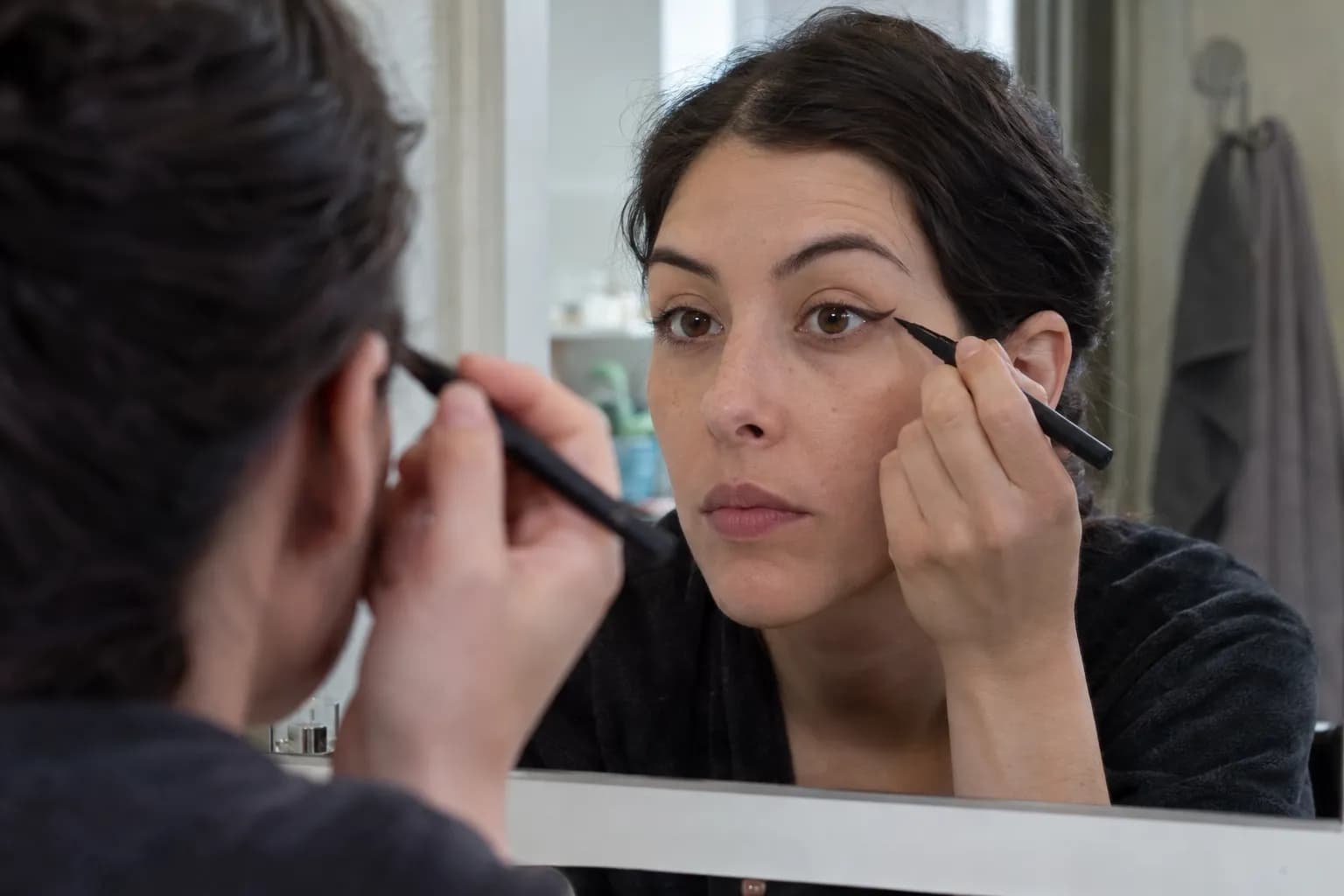
For eyeliner for hooded eyes, keep the lash line thin and map your wing with your eyes open, looking straight ahead. If your crease interrupts the wing, an eyes-open bat-wing shape can keep it looking connected instead of disappearing into the fold. This guide covers that technique, subtle tightlining, transfer-resistant formulas, and how to troubleshoot the shape on your own eyes.

See your colors on your face
Vella Studio finds your color season from a selfie and tries makeup looks on your own photo.
Why eyeliner for hooded eyes disappears
Hooded eyes have a fold of skin that overlaps some of the mobile lid—the part that moves when you blink. You may see plenty of lid with your eyes closed, then much less when you open them. Hooding can also differ between eyes, so identical lines on closed lids may look uneven from the front.
A classic wing is usually drawn as a smooth triangle with the eye closed or the brow lifted. That creates two common problems:
- The lid line vanishes: the fold covers the liner when your face relaxes.
- The wing breaks: the crease crosses the triangle, hiding its middle or making the edge look bent.
Making everything thicker rarely solves both problems. It can cover the little lid space you do have while leaving the wing interrupted.
Check where your fold actually sits
Put a mirror at eye level in even light. Look straight ahead, relax your forehead, and blink naturally. Notice where the outer fold ends relative to your outer corner.
If there is clear space beyond the fold, a small conventional flick may work. If the fold crosses your intended wing, try the bat-wing method below. If the fold extends low beyond the corner, a shorter, more outward flick may be easier than a steep one.
Hooded describes lid structure, not the entire eye shape: you can also have almond, round, or downturned eyes. Use our five-step eye shape test to check your eye opening, crease, and corner tilt separately. The hooded eyes guide can help you recognize that distinction before choosing a wing angle. If you have monolids, see our makeup guide for monolid eyes for shadow, liner, and lash placement.
Draw a bat wing with your eyes open
A bat wing is an adjustment for a fold, not necessarily a dramatic makeup look. It appears smooth when your eyes are open but may have a notch or stepped edge when they are closed. That unusual closed-eye outline compensates for the skin that folds away.
Start with a fine pencil or a small amount of gel on a pointed brush. Once the placement works, you can sharpen it with liquid liner.
1. Set up without stretching your lid
Rest your elbow on a stable surface and place your mirror directly in front of you. Keep your chin neutral and your brows relaxed. Raising your eyebrows reveals more lid, but it also changes the shape you are trying to fit.
Gently blot excess skincare from the lid. If you use eye primer, apply a thin layer and let it settle before drawing.
2. Mark a modest endpoint
With both eyes open, place a tiny dot just beyond the outer corner where you want the wing to finish. A useful first attempt is only a few millimeters long; you can extend it later.
Aim slightly outward and upward, but do not automatically point toward the brow tail. The best angle is one that stays readable around your fold. Check both dots from the front before connecting anything.
3. Sketch the lower edge
Draw a fine stroke from the outer corner toward your dot. Use light pressure and short strokes rather than one forceful sweep.
If a steep angle runs directly into folded skin, lower the angle slightly or shorten the flick. You are looking for a path that remains visible with your face relaxed, not a predetermined angle.
4. Map the upper edge while looking ahead
From the endpoint, sketch the upper edge back toward the outer lash line, keeping your eye open. Where the fold hides skin, mark the visible portions rather than pushing liner into the crease.
The goal is a small, connected-looking wedge from the front. Do not worry yet about making it a smooth triangle on a closed lid.
5. Lower your gaze and connect the marks
Now look down or partially close your eye without pulling the skin. You may see a gap or offset between the marks you made. Connect them with a short angular step, then fill only the area needed to make the open-eye wing look solid.
Keep the notch if the open-eye shape works. Filling it into a traditional triangle is often what makes the liner too thick or distorted again.
6. Add the thinnest possible lash line
Work from the outer third inward with small strokes, keeping pigment close to the lashes. You do not have to reach the inner corner. Leaving the inner third bare can preserve a lighter look, especially when little lid shows.
Let the formula set according to its directions, then blink and check both eyes straight on. Adjust the visible length and angle—not the hidden geometry—so the wings look balanced when your face is relaxed.
Tightlining: definition without a thick lid stripe
Tightlining adds darkness close to the base of the upper lashes, so you get definition without using much visible lid space. The term often means lining the upper waterline, but you can also create a similar visual effect by filling gaps between the lashes from above.
For hooded eyes, start with the lash-root approach. It gives you more control over placement and avoids making waterline liner a required step.
How to fill the lash roots
- Choose a finely sharpened eye pencil or a small detail brush with a little gel liner.
- Look slightly down into a mirror without pulling the outer corner sideways.
- Place tiny dots on the skin between the upper lash bases, approaching from above. Do not press into the eye.
- Connect only obvious gaps, concentrating on the outer half if you want a subtle lift.
- Look straight ahead. Your lashes should look more defined without a broad stripe above them.
If you specifically want to line the upper waterline, use only a product labeled suitable for that area, follow its directions, and keep tools clean. Waterproof does not automatically mean waterline-safe. Stop if application feels uncomfortable or causes irritation; persistent symptoms warrant professional advice.
Black gives the strongest lash-density effect. Deep espresso is softer, while charcoal offers definition without a warm brown tone. You can pair any of these with a tiny outer flick rather than a full wing.
Choose liner formulas that resist transfer
On hooded lids, liner can touch the skin above it during blinking or while your eyes are open. Transfer resistance therefore matters as much as how smoothly a formula draws.
No finish or format guarantees zero transfer on every lid. Look for quick-setting, long-wear or transfer-resistant claims, and remember that water resistance is not the same as resistance to skin oils or rubbing.
| Formula | Best use on hooded eyes | What to look for | Main watch-out |
|---|---|---|---|
| Fine-tip liquid | Thin lash lines and sharp bat wings | Quick-setting, flexible, transfer-resistant wear | A wet line can stamp onto the fold before setting |
| Pot or pen gel | Controlled wings and lash-root detail | A formula that sets after a short working window | Thick layers may remain tacky or look bulky |
| Waterproof pencil | Root definition and soft outer flicks | Fine tip and a set-down, long-wear finish | Very creamy pencils may migrate despite being waterproof |
| Soft kohl | Deliberately smoky, diffused liner | Easy blending when softness is the goal | Usually less suited to a crisp, transfer-resistant wing |
| Powder shadow | Soft definition or setting compatible pencil | Finely milled matte texture | It may fade or scatter and is not a waterproof substitute |
Give the liner a clean surface and time to set
Keep rich skincare away from the immediate liner path when applying makeup, and gently blot excess shine before starting. If you use primer, keep the layer thin; more product is not automatically better.
After drawing, look down briefly so the wet line is less likely to touch the hood. Avoid repeatedly opening wide to inspect it before it sets. A tiny amount of matching matte shadow can soften or help set some pencil liners, but it will not turn every creamy formula into a transfer-proof one.
Test a thin line at home and check it after normal blinking and wear. A clean duplicate stripe above the crease suggests contact transfer; a spreading haze along the lashes suggests migration. Those need different fixes: drying time or placement for the first, and a better-setting formula or less product for the second.
Match the shade and placement to your look
You do not need black liner for a visible wing. Depth, contrast, and edge definition all influence the result.
- Soft everyday definition: choose espresso, deep cocoa, or charcoal brown. Keep the inner half extremely fine and let only the outer flick become slightly wider.
- Crisp, graphic definition: use black or black-brown with a clean, tapered endpoint. Make the wing sharper rather than thickening the whole lid line.
- Warm, muted color: try deep bronze-brown, dark olive, or aubergine with a brown base. Keep metallic finishes fine and close to the lashes if you want a precise outline.
- Cool, muted color: choose slate, smoky navy, or deep plum. These give a colored-liner effect without needing a broad band across the lid.
Warm taupe and dusty rose work well as surrounding shadow shades, but they may be too light to define a wing on some skin tones. Choose your liner by how clearly it shows against your own skin, not just its shade name. If you are unsure whether warmer or cooler colors feel more harmonious, the Undertone Finder is an optional starting point—not a rulebook. For practical checks, see our guide to finding your undertone.
For minimal visible lid space, concentrate color between the lashes and at the outer corner. If one eye is more hooded, it may need a slightly different notch or thickness. Aim for the same visual effect with eyes open, rather than matching every millimeter with eyes closed.
Common mistakes—and how to diagnose them
Before adding more liner, identify whether the problem is shape, placement, or formula. More pigment can make all three harder to troubleshoot.
Your wing looks good closed but bends open
Likely cause: you mapped it on stretched skin, or the fold crosses a conventional triangle.
Remove the outer wing and mark its endpoint again with your eyes relaxed. Try an eyes-open bat wing, preserving the small notch when you lower your gaze. Simply extending the existing triangle usually keeps the same underlying problem.
Your entire visible lid looks dark
Likely cause: the lash line became too thick while you tried to make it visible above the hood.
Keep the lid line tucked into the lash roots and move the emphasis outward. You do not need a continuous visible stripe across the entire eye for liner to look intentional.
A second line appears above your lashes
Likely cause: the liner touched the hood before setting, or the formula remains too mobile.
Use a thinner layer, allow more setting time, and check whether the line sits directly in a contact zone. If transfer continues, switch to a quicker-setting formula rather than piling powder over it.
The wing looks hooked or points downward
Likely cause: the outer fold is interrupting the upper edge, or the lash line has been extended too far downward before the flick begins.
Check the outer corner with your eyes open. Shorten the wing and try a more outward angle that avoids the deepest part of the fold. A small flick is often easier to fit than a long, steep wing.
One wing keeps getting bigger
Likely cause: you are chasing closed-eye symmetry with repeated additions.
Pause and look straight ahead from a normal conversational distance. Remove excess from the larger wing with a precise, barely damp cleanup tool, let the area dry, and redraw only what is missing. Balance the visible tips first.
Check your placement with Vella
If you want a starting shape before drawing, try the free browser Eyeliner Shape Finder. Use the suggested placement as a reference, then check it against where your fold sits with your eyes open.
The Vella Studio app can map eyeliner to your eyes and draw it on your photo. Its photorealistic makeup try-on includes a before/after slider, so you can compare the visual effect on your own face. A photo preview helps with shape and proportion; it cannot tell you whether a real formula will transfer during blinking, so keep the wear test separate.
A simple routine for your next attempt
Keep your first version small enough to correct easily. You need one fine eye pencil or liner, a mirror at eye level, and a precise cleanup tool—not several competing formulas.
- Observe: relax your brows and find where the outer fold ends.
- Define: fill a few gaps between the upper lash roots, especially on the outer half.
- Map: place two small wing-tip dots with both eyes open.
- Connect: draw short flicks; use a bat-wing step only where a fold interrupts the shape.
- Set: let the liner dry before normal blinking, following its directions.
- Check: compare the visible tips and look for transfer before adding more product.
The useful benchmark is not a perfect triangle on a closed eyelid. It is a line that looks intentional when you are looking ahead, with enough visible lid left for the effect you want.
Frequently asked questions
What type of eyeliner is best for hooded eyes?
A fine-tip, quick-setting liquid liner works well for crisp wings, while a setting gel or long-wear pencil is useful for lash-root definition. Prioritize transfer resistance and thin application rather than assuming every waterproof formula will stay put.
Should you apply eyeliner with hooded eyes open or closed?
Map the wing with your eyes open, looking straight ahead with your brows relaxed. Then lower your gaze to connect small gaps and fill the shape. Check the finished result with your eyes open before making adjustments.
What is bat-wing eyeliner for hooded eyes?
Bat-wing eyeliner has a notched or stepped outline that compensates for a lid fold. It looks connected with your eyes open, even though it may look angular when they are closed. You only need that adjustment where the crease interrupts your wing.
Can you tightline hooded eyes without lining the waterline?
Yes. You can dot eye liner between the upper lash bases from above to add definition without drawing on the waterline. Keep the application gentle and precise, and do not press the tool into your eye.
Why does my eyeliner transfer onto my upper eyelid?
The hood can touch the liner before it dries, leaving a duplicate mark above the lash line. Transfer can also happen when a formula stays creamy or moves during wear. Try a thinner layer, adequate setting time, and a quicker-setting formula if needed.
Try it on your own face
Vella Studio finds your color season and shows every look on your photo — every shade named, so you know exactly what to buy.