- Face Shape
- Face Shape
- Haircuts
- Hair Styling
- Bangs
Hairstyles for Round Face: Cuts, Layers and Bangs
Vella Beauty Editors••11 min read

The most useful hairstyles for round face proportions create a little height above the forehead, leave longer lines beside the cheeks, or combine both. Collarbone lobs, long layers, tapered crops and open fringes can all do this—you do not need long, straight hair. This guide explains which lengths, layers, parts and bangs create that effect, plus how to adapt them to your natural texture.

See your colors on your face
Vella Studio finds your color season from a selfie and tries makeup looks on your own photo.
How to tell whether your face is round
A round face usually has similar overall length and width, fuller-looking cheeks and a softly curved jaw. Your cheek area is often the widest point, but no single feature confirms your shape: full cheeks can also appear on oval, heart-shaped and square faces.
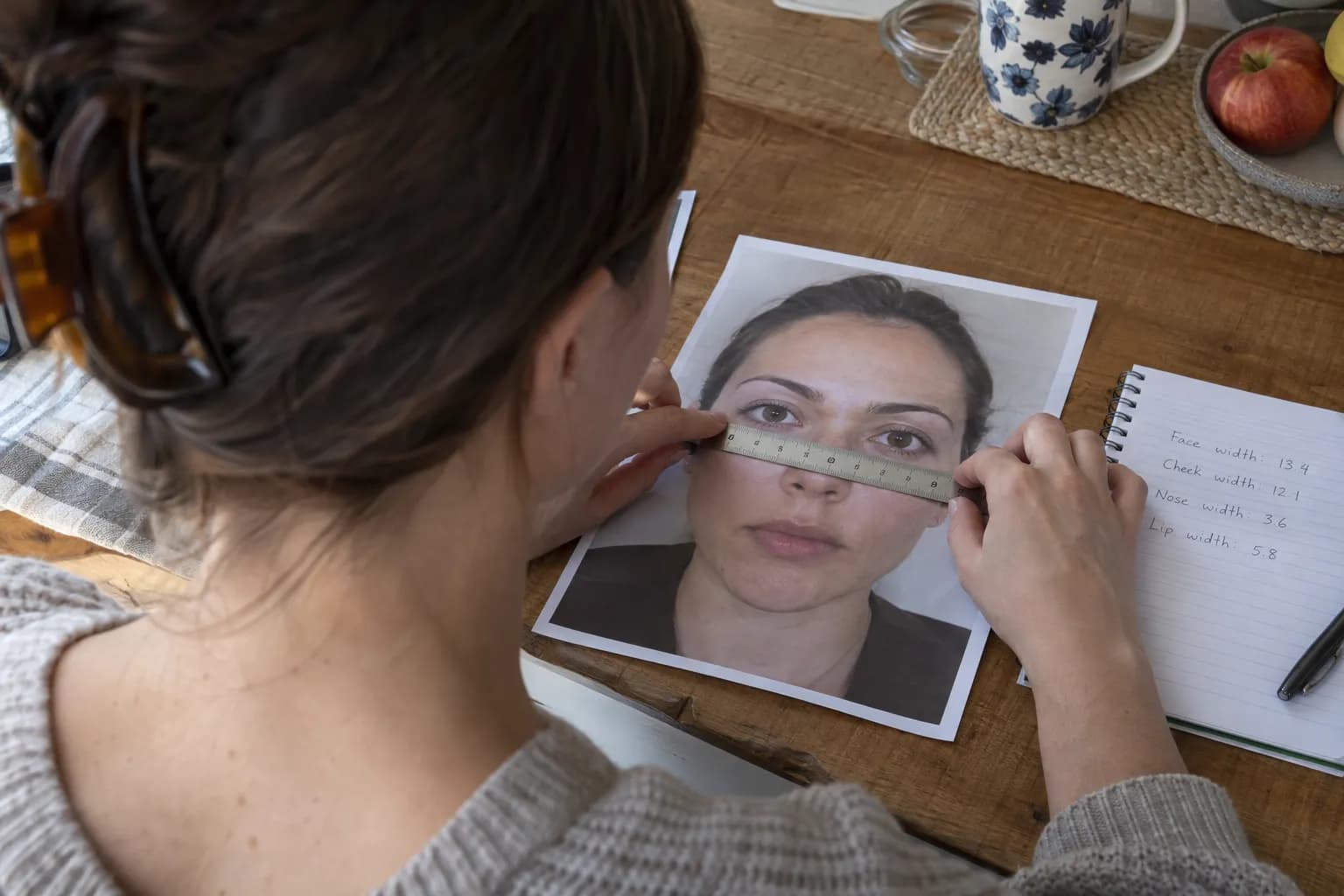
To check, pull your hair away from your face and look straight into a mirror. Compare your forehead-to-chin length with your cheekbone width, then notice the outline of your jaw. A noticeably longer outline suggests oval or oblong proportions; a more angular jaw may point toward square proportions.
If you are unsure, use this four-step guide to finding your face shape. Many faces sit between categories, so treat the label as a starting point, not a haircut prescription.
Decide what you actually want to change
A round face does not need correcting. The advice here serves a specific goal: making your face appear a little longer through the surrounding hair silhouette.
Check where your current cut feels widest. Is it at the temples, across the cheeks or around the jaw? That tells you more about the useful adjustment than simply deciding your hair is too short. The round face shape guide can help you compare the overall proportions.
Hairstyles for round face: choose your length by silhouette
Length alone does not determine whether a haircut creates an elongated effect. A long cut with flat roots and wide cheek-level volume may look rounder than a short cut with a tapered outline and lifted top.
| Length or cut | Detail that can add visual length | What to discuss with your stylist |
|---|---|---|
| Tapered pixie | Longer top with a less rounded outline at the sides | Enough top length to lift or sweep diagonally |
| Bixie or short layered crop | Side-swept front and controlled temple volume | Avoiding a uniformly round shape around the head |
| Bob | Front pieces that finish below the jaw | Where the ends will sit when completely dry |
| Collarbone lob | Longer front edges and a gently broken-up perimeter | A weight line that suits your density |
| Shoulder-length cut | Face framing that continues past the cheeks | Keeping movement without a broad outward flip |
| Long hair | Crown movement and layers below the jaw | Retaining full ends instead of over-layering |
Short hair: keep a directional shape
A pixie can suit a round face beautifully. Ask for a longer top that you can lift or sweep, with sides that do not form a matching rounded dome. That does not mean the sides must be shaved or pressed flat.
For a bob, look at the landing point of the front corners. Ends resting directly against the fullest part of your cheeks emphasize that area. A slightly longer front can create a more vertical line while preserving the ease of a short cut.
Medium hair: use the collarbone as a starting point
A collarbone lob is a flexible option because the front sections extend below the face without requiring very long hair. A subtle forward angle can help, but a dramatic angled bob is not necessary.
Shoulder-length ends sometimes flip outward where they meet your shoulders. If that creates more width than you want, ask whether slightly more or less length would make daily styling easier.
Long hair: preserve movement and density
Long hair creates length beside the face, but it can also pull the roots flat. Keep enough movement through the upper lengths to avoid a heavy, motionless outline. If your hair is fine, a fuller perimeter with limited layering may serve you better than lots of short layers.
Place layers where they change the outline
The useful question is not simply, “Should I get layers?” It is, “Where will the shortest layers fall, and where will the hair become fullest?”
For a longer-looking outline, a practical starting point is face-framing pieces around the chin or below, continuing into longer lengths. On wavy or curly hair, judge this placement in its dry, naturally contracted state.
Separate face framing from all-over layering
Face-framing layers shape the pieces beside your face. All-over layers redistribute weight throughout the haircut. You may need one without much of the other.
- Fine or lower-density hair: Keep the bottom edge relatively full. A few longer front pieces can add shape without making the ends look sparse.
- Dense straight or wavy hair: Carefully placed internal layers can reduce bulk without leaving a short, expanding shelf beside the cheeks.
- Curly or coily hair: Layers can create height and balance, but their placement should follow your curl pattern, shrinkage and preferred finished shape.
Short crown layers can create lift, but they may also stick out or become difficult to gather into a ponytail. If you air-dry most days, ask your stylist to plan the outline around air-dried behavior rather than a salon blowout.
Bring a reference showing your desired silhouette, then point to where you want the shortest front piece to land. “Keep the volume above or below my cheeks, rather than directly beside them” is more actionable than “Make my face look slimmer.”
Use part placement and bangs to open the face
A part changes how hair falls across your forehead and cheeks. Bangs change how much forehead remains visible. Together, these details can alter the apparent proportions without a major haircut.
Center, off-center or deep side part?
A center part can create two long vertical lines, especially when the front pieces fall below the jaw. It is not automatically wrong for a round face. However, flat roots combined with wide, outward-curving sides can make the overall outline feel broader.
An off-center part adds gentle asymmetry while keeping the hair balanced. Start just to one side of your natural center, then check whether the heavier side sweeps diagonally or simply piles up beside one cheek.
A deep side part creates a stronger diagonal across the forehead. Give the roots a little lift and let the front sweep away from your eye; a dense curtain covering most of the forehead may shorten the visible face instead.
Test parts with slightly damp roots. Move the part, dry the roots into position and compare at eye level in the same mirror. Your cowlick may make one placement much easier to maintain.
Bangs that leave an open center
Long curtain bangs can work well when they separate through the middle and taper toward the cheekbones or jaw. The open center preserves some visible forehead, while the longer outer pieces create movement.
For a more elongated effect, avoid styling the outer wings into their widest curl directly beside the fullest part of your cheeks. Let them sweep back or continue downward instead.
Other useful options include:
- Side-swept bangs: A diagonal front section that blends into longer side pieces.
- Wispy, separated bangs: A lighter fringe that leaves some forehead visible.
- Long curly fringe: Pieces shaped around your dry curl pattern, with room for separation rather than a solid horizontal band.
Heavy, straight-across bangs are not forbidden, but they shorten the visible forehead and introduce a strong horizontal line. If you love them, balance that effect with longer sides and some height through the top.
Style your texture without fighting it
You do not need to straighten textured hair to make a round face look longer. Work with where your hair naturally expands, then direct the finished silhouette.
Straight hair
Straight hair makes the perimeter especially visible, so the placement of the ends matters.
- Establish your part while the roots are damp.
- Lift the top sections upward as you dry, rather than brushing everything flat against the scalp.
- Keep the front lengths falling down or slightly back, with a soft bend below the jaw.
Avoid turning every front section sharply inward at cheek height if that creates a circular frame. For fine hair, concentrate heavier smoothing products on the ends so the crown is less likely to collapse.
Wavy hair
Waves can create an elongated outline when their fullest bends sit below the cheeks rather than directly beside them.
- Set your part before the waves dry.
- Apply your preferred lightweight styler through damp lengths and encourage the natural wave pattern.
- Once dry, assess the front pieces before reshaping anything.
If one front wave flips outward at cheek level, dampen that piece and guide it downward or back while it resets. You do not need to flatten the rest of your texture to adjust one distracting bend.
Curly hair
Focus on the overall curl silhouette, not on making every curl smaller. A cut with some height through the top and balanced volume at the sides can create length while staying full.
- Style with your usual curl-defining technique so the cut behaves predictably.
- If you diffuse, use a comfortable low airflow and avoid constantly moving the front curls around.
- Once completely dry, lift gently at the crown roots without pulling apart the entire curl pattern.
If the shape becomes triangular or very wide at cheek level, extra product may not solve it. Ask your stylist whether the layering or weight distribution needs adjusting. Assess fringe and face-framing length with dry curls, not stretched strands.
Coily hair
Coily hair offers many ways to build height: shaped natural cuts, twist-outs, braid-outs, tapered silhouettes and high puffs. A rounded afro is also a valid choice; elongation is an optional styling goal, not a rule.
For more vertical emphasis, gently lift the top after your chosen set has fully dried, then shape the sides to your preferred width. Avoid pulling the perimeter tight simply to make it narrower.
With braids or twists, part placement and arrangement can create the same directional lines as loose hair. Try an off-center arrangement or a softly gathered high style, keeping tension comfortable and leaving the hairline unstrained.
Cuts to approach carefully—and how to diagnose problems
There are no universally banned haircuts for round faces. These combinations simply deserve a closer look if your goal is visual length.
A jaw-length bob with a rounded finish
A bob that curls under at the jaw can create a circular outline, especially with a full fringe. If yours feels too round, first try a less tucked-under finish or an off-center part. You may not need a different cut; if you do, slightly longer front sections could help.
A shag with its widest layers at the cheeks
Shags and wolf-inspired cuts can work, but short side layers may expand exactly where you want less width. Ask where the finished cut will be fullest in your natural texture. Keeping the front layers longer can change the effect without abandoning the style.
Long hair with no root movement
More length is not always the answer. If your roots lie flat while the sides spread outward, try lifting the crown and changing the front placement before growing your hair further.
Over-layering fine hair
Removing too much weight can leave thin ends and a fuller-looking upper section. If your ponytail feels noticeably sparse after a cut, ask for a stronger perimeter next time rather than adding more layers to chase volume.
Judging a haircut from one selfie
Close camera distance, head tilt and lens distortion can change apparent proportions. Check your hair from the front and a three-quarter angle in a mirror. Compare it fully dry, in your normal part, before deciding the length is wrong.
Make the cut work on everyday styling days
A flattering haircut should still feel like yours when you have ten minutes, not only after a full blowout.
For an easy updo, place a bun or puff where it creates the amount of height you enjoy. Keep the sides comfortable rather than tightly scraped back. If you leave loose front pieces, try pieces that extend past the jaw instead of bunching into short curls beside the cheeks.
For a ponytail, loosen the crown slightly after securing it, then check the profile as well as the front. A little lift is often enough; a tall, stiff bump is not required.
Before your appointment, save three references with hair texture and density reasonably similar to yours. Tell your stylist:
- Where you want the front pieces to finish when dry.
- Whether you air-dry, diffuse or heat-style.
- Whether the cut must fit into a ponytail.
- How often you are willing to trim bangs.
Ask to see the finished shape in your normal part. A cut that depends on an unfamiliar part or daily fringe styling may not be the practical choice, even if the reference photo looks perfect.
Check your face shape with Vella before committing
For a starting point, try the free Face Shape Detector. Compare its result with your own observations, especially if you seem to fall between two shapes.
The Vella Studio app provides face-shape guidance for haircuts, brows and contour. Its photorealistic try-on lets you preview makeup on your own photo; that is separate from its haircut guidance, not a hairstyle preview.
Use the guidance to narrow your reference photos, then let a stylist assess texture, density, growth patterns and shrinkage in person. Those details determine how a promising silhouette will actually fall on you.
Frequently asked questions
Is short or long hair better for a round face?
Either can work. For a longer-looking outline, short hair benefits from a directional top and less rounded sides, while long hair benefits from root movement and face framing that extends below the cheeks. The finished silhouette matters more than length alone.
Do bangs suit a round face?
Yes. Long curtain bangs, side-swept bangs and light, separated fringes can leave the forehead partly visible and create diagonal lines. A dense, straight-across fringe creates a shorter-looking face, which you can balance with longer side pieces if desired.
Is a middle part good for a round face?
A middle part can work well when the front lengths form vertical lines beside your face. If the roots sit flat and the sides expand at cheek level, try adding crown lift or moving the part slightly off-center. Your natural growth pattern should also guide the choice.
What is a low-maintenance haircut for a round face?
A collarbone lob with restrained layering can be manageable for straight or wavy hair, depending on density and growth patterns. For curly or coily hair, a shape designed around your natural dry texture may require less daily reshaping. Avoid committing to bangs unless their styling and trim schedule fits your routine.
Can curly hair make a round face look longer?
Yes—curly hair does not need straightening to create visual length. A balanced shape with some crown height can achieve that effect while preserving fullness. Ask your stylist to assess where the curls expand and where the front pieces land when dry.
Try it on your own face
Vella Studio finds your color season and shows every look on your photo — every shade named, so you know exactly what to buy.