- Face Shape
- Face Shape
- Beauty Guides
- Makeup Placement
- Haircuts
How to Tell Your Face Shape: A Clear 4-Step Guide
Vella Beauty Editors••11 min read
To learn how to tell your face shape, compare four measurements—forehead, cheekbones, jaw, and face length—then look at your jaw’s outline and how sharply your chin tapers. The guide below shows you where to measure, how to distinguish the seven common shapes, and what your result actually changes about makeup and hair choices.

See your colors on your face
Vella Studio finds your color season from a selfie and tries makeup looks on your own photo.
How to tell your face shape with four measurements
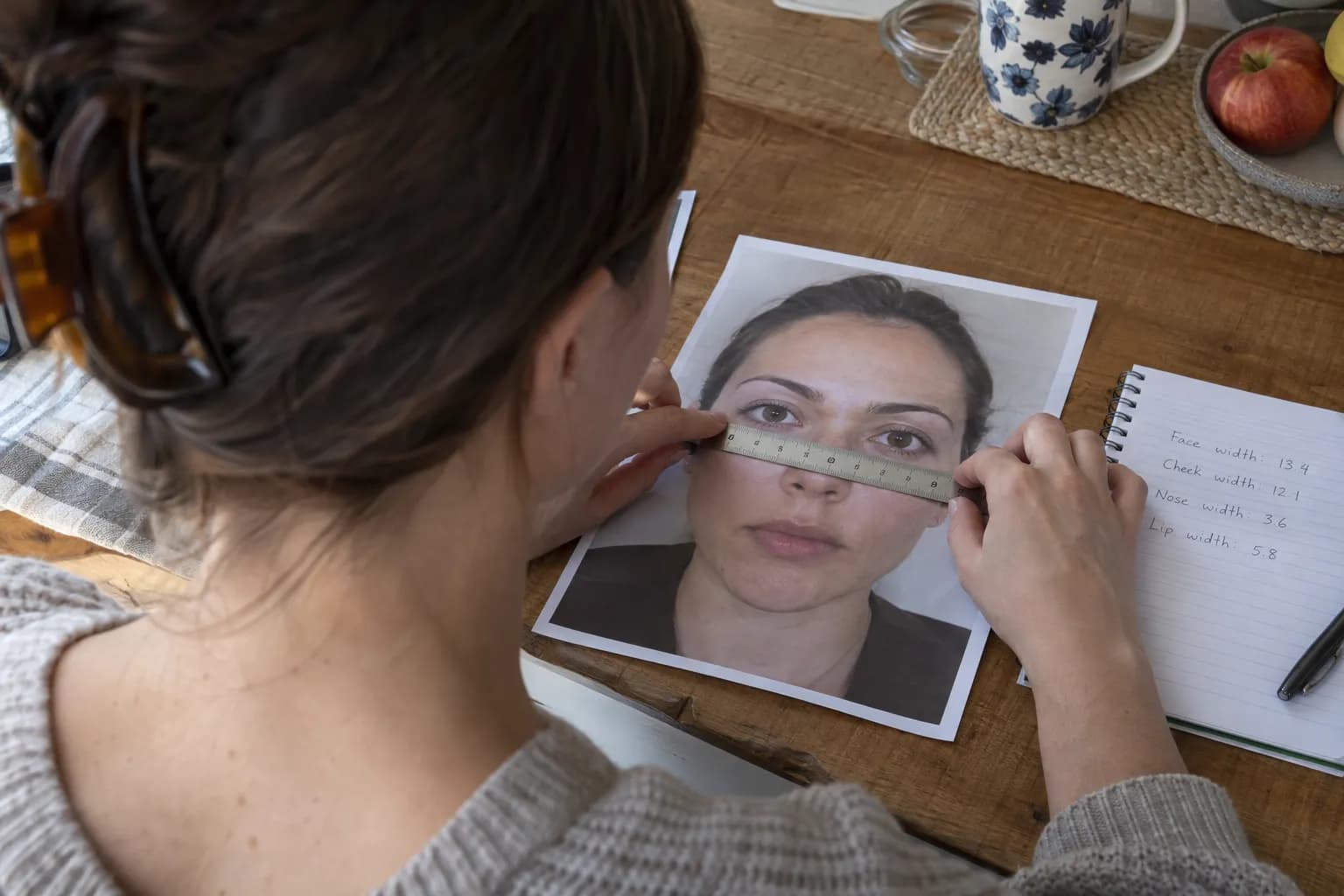
You need a mirror, a straight-on photo, and a way to compare distances. A ruler on a printed photo or a simple line-measuring tool on an image is enough: the proportions matter more than the units.
Photo measurements are often easier to compare than measurements taken with a tape wrapped around your face. A tape follows curves, while a face-shape outline is about the widths you see from the front.
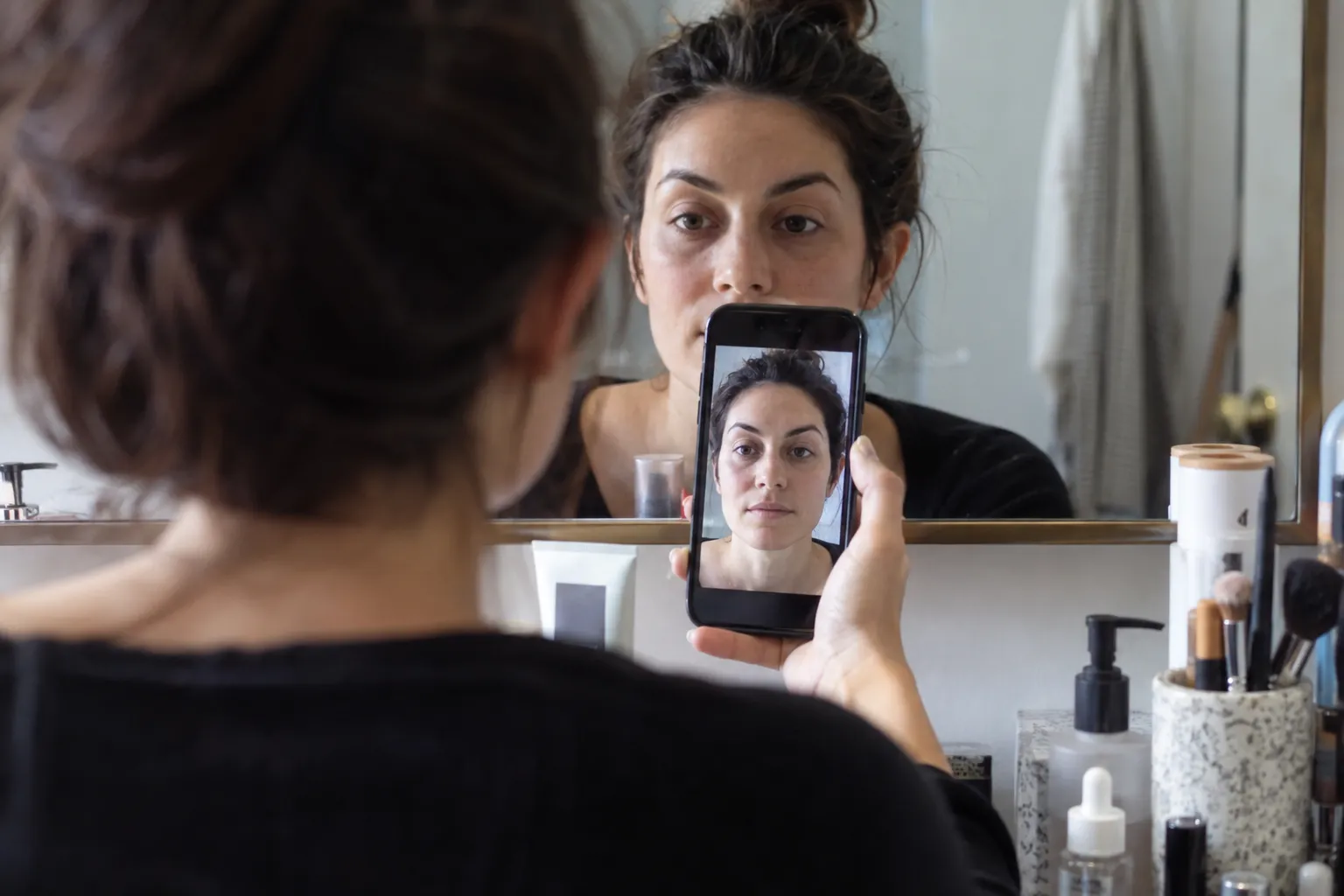
Set up a useful photo first
Pull your hair away from your temples and jaw, including any fringe. Keep your head level, your eyes looking straight ahead, and your expression relaxed. Avoid smiling broadly or clenching your jaw, since both change the visible outline.
Place the camera at eye level and avoid a close, wide-angle selfie. If possible, have someone take the picture from a little farther away, then crop it. Use even light so a shadow doesn’t make one side of your jaw appear narrower.
You’re looking for a representative view, not a perfectly symmetrical image. Small left-to-right differences are normal.
1. Measure your forehead width
Measure across the broadest visible part of your forehead, usually between the outer forehead edges above your brows. Use the edges of the forehead itself, not stray hair or the outer volume of your hairstyle.
Hairlines vary, so this measurement can be less clear than the others. If you have deep temple recession or a very irregular hairline, note the uncertainty rather than forcing a precise number.
2. Measure your cheekbone width
Find the outermost cheekbone points below and to the outside of your eyes. Measure straight across between them.
Don’t automatically use the fullest part of your lower cheeks. You’re identifying the upper cheekbone span, which helps distinguish a cheekbone-dominant diamond outline from a forehead-dominant heart outline.
3. Measure your jaw width
Locate the two jaw corners where the lower jaw turns upward toward the ears. Compare the straight-across distance between those points in the photo.
Some guides measure from one jaw corner to the chin and double it. That describes a different distance, so don’t mix that method with straight-across forehead and cheekbone widths. For this guide, keep all three width measurements in the same front-facing plane.
If your jaw corners are soft or difficult to locate, estimate their positions and put more weight on the overall outline.
4. Measure your face length
Measure from the center of your hairline straight down to the bottom of your chin. Keep the line vertical rather than following the curve of your forehead and nose.
Write down all four measurements, then ask:
- Which width is clearly largest?
- Are the three widths fairly similar?
- Is your face only slightly longer than it is wide, or noticeably longer?
- Does the lower face round off, stay broad, or taper toward the chin?
There is no universally agreed numerical cutoff for these everyday beauty categories. A tiny measurement difference shouldn’t overrule an obvious overall pattern.
The seven face shapes at a glance
Use this table to find your closest match, not to grade your face against a template. “Widest” refers to the relative widths on your own face—not whether your face looks wide in general.
| Face shape | Typical width pattern | Length and outline clues | Most useful distinction |
|---|---|---|---|
| Oval | Cheekbones often slightly wider than forehead and jaw | Longer than wide, with a gently narrowing lower face | Balanced taper rather than pronounced length or a sharp chin |
| Round | Cheekbones often widest, with soft transitions | Length and width relatively close; rounded jaw and chin | Soft outline rather than square jaw corners |
| Square | Forehead, cheekbones, and jaw fairly similar | Length and width relatively close; visible jaw angles | Lower face stays broad rather than tapering strongly |
| Heart | Forehead or upper face broader than jaw | Lower face narrows toward a smaller, sometimes pointed chin | Upper-face width is more prominent than jaw width |
| Diamond | Cheekbones clearly wider than forehead and jaw | Narrower forehead and tapered lower face | Cheekbones—not the forehead—dominate the outline |
| Oblong | Widths may be similar, or cheekbones slightly wider | Face is noticeably longer than wide; sides often look relatively straight | Length is the strongest feature |
| Triangle | Jaw broader than forehead, often broader than cheekbones | Lower face is widest; chin may be rounded or angular | Width increases toward the jaw |
These names aren’t perfectly standardized. “Oblong” is sometimes called “long,” while “rectangle” often describes an elongated outline with a more angular jaw. Triangle may also be called pear-shaped; here, it means a broader jaw and narrower forehead, not an inverted triangle.
A widow’s peak isn’t required for a heart-shaped face. Likewise, a pointed chin alone doesn’t establish a diamond shape—the cheekbone-to-forehead relationship matters more.
Narrow it down when two shapes look right
If several rows sound familiar, compare your two closest options directly. Trying to evaluate all seven at once usually makes the process harder.
Round versus square: check the jaw corners
Both can have fairly similar length and width. The difference is usually the transition from the sides of the face into the jaw.
A round outline curves gradually into the chin. A square outline has more visible corners and retains width through the lower face. Full cheeks don’t automatically mean round: you can have full cheeks over an angular, square-leaning jaw.
Oval versus oblong: check what dominates
Both are longer than wide. With an oval outline, you tend to notice a gently curved perimeter and a gradual taper. With an oblong outline, you tend to notice length first, often with a longer-looking middle or lower face.
Don’t chase a particular length-to-width ratio. If both seem plausible, “long oval” is a useful description. The oval face shape guide can help you explore styling ideas without treating the label as a rule.
Heart versus diamond: check above the cheekbones
Cover the lower half of your photo with your hand and compare the forehead with the cheekbones. If the forehead looks broad and the face then narrows downward, heart is more likely. If the outline expands noticeably from a narrower forehead to the cheekbones, diamond is more likely.
Then uncover the lower half. Both can taper toward the chin, so the chin alone won’t settle this comparison.
Square versus triangle: compare jaw and forehead
A strong jaw can appear in either shape. If the forehead, cheeks, and jaw are broadly similar in width, square is the closer description. If the jaw is clearly broader than the forehead, triangle is more useful.
For any close call, repeat the assessment using a second straight-on photo. If the difference disappears when the camera position changes, you’re probably looking at a photography effect rather than a defining feature.
Why most people are a mix of face shapes
Face shapes are simplified styling categories, not seven separate anatomical boxes. Your forehead, cheekbones, jaw, and chin can each contribute a different pattern, which is why most people won’t match every feature in one row.
You might have an oval overall outline with a square jaw, or a round outline with a slightly heart-shaped taper. Neither is a failed result. A two-part description is often more useful than a single label.
Try describing your face with three observations:
- Overall proportion: compact, moderately long, or distinctly long.
- Widest area: forehead, cheekbones, jaw, or no obvious winner.
- Lower-face outline: rounded, angular, or tapered.
“Moderately long, widest at the cheekbones, with an angular jaw” gives you practical information even if you never settle on oval or diamond.
Visible fullness, expression, hairstyle, and camera position can also affect how the outline reads. That doesn’t mean your previous assessment was wrong; it means a label compresses a lot of detail. Choose styling based on the feature you actually see, not on proving that you belong in one category.
What face shape actually changes about your look
Face shape can help you predict how placement, volume, and direction will look against your natural outline. It doesn’t determine your attractiveness, your best makeup colors, or which trends you’re allowed to wear.
You also don’t have to make every face look oval. Decide whether you want to emphasize your structure, soften it, or simply try a different effect.
Blush placement: choose direction deliberately
For a lifted effect on a round or compact outline, place blush on the upper outer cheek and blend toward the temple. Start lightly, keeping the strongest color away from the area immediately beside your nose.
If you want a long face to look a little less elongated, try a shorter, more horizontal sweep across the cheeks rather than extending the color high toward the hairline. Keep it blended, not stripe-like.
For prominent cheekbones, start on the cheek’s forward-facing surface and diffuse outward. Placing all the color at the outermost cheekbone point can emphasize width, which may be exactly what you want—or not.
Shade is a separate decision. Dusty rose or muted berry may suit a cooler palette; warm peach or terracotta may suit a warmer one. Depth and saturation still matter. If color is the sticking point, the Undertone Finder is more relevant than your face-shape label. If muted, gently warm shades suit you, explore the Soft Autumn color palette and makeup guide.
Contour and highlight: work on specific areas
Contour creates the appearance of shadow; it doesn’t need to trace your entire perimeter. Choose a matte shade that resembles a natural shadow on your skin: a subdued taupe, neutral brown, or deeper neutral brown depending on your coloring.
- To soften a broad jaw visually: blend a small amount around the outer jaw corners, keeping obvious edges out of view.
- To reduce emphasis on a broad upper forehead: use a sheer application near the outer hairline rather than a heavy band across the forehead.
- To avoid exaggerating a long face: skip an extended vertical highlight running from forehead to chin. Keep luminosity more localized.
- To celebrate cheekbone width: use a restrained satin highlight along the upper cheekbone. A highly reflective finish will attract more attention there.
Check everything straight on and from the side in ordinary light. A placement that works in a front-facing photo can look too sharp in person.
Haircuts and brows: look at where volume sits
If you want to emphasize length, extra height at the crown and less width at the sides can support that effect. If you want to soften the impression of length, a fringe or some side volume may help interrupt the vertical outline. For a round outline, explore these hairstyles for a round face for cuts, layers, and bangs that create visual length.
For a broad jaw, notice where the fullest part of a haircut ends. Volume ending exactly at the jaw can emphasize that area; moving the fullness above or below it changes the focus. Hair texture, density, maintenance, and personal taste matter just as much as face shape.
With brows, compare a softly rounded arch with a more defined angle, but preserve the logic of your natural growth. Don’t overpluck to follow a face-shape chart.
What the label does not decide
Face shape doesn’t tell you whether brick red lipstick, dusty rose blush, or warm taupe eyeshadow is your best color. Undertone, depth, contrast, and preference are more relevant to those choices.
It also doesn’t determine your ideal eyeliner wing. Lid space, folds, and eye angle are more useful; the Eye Shape Quiz addresses that separate question.
Common mistakes that lead to the wrong result
Before changing your label—or your haircut—check these common sources of confusion.
Measuring a tilted photo. A raised chin can alter the apparent jaw and face length; turning slightly changes the visible widths. Retake the photo with the camera centered and your head level.
Using hairstyle as part of the outline. Temple volume can make a narrow forehead appear broad, while a fringe hides the hairline. Pull hair back for assessment, then put it down when evaluating styling.
Treating cheek fullness as cheekbone width. Check the upper cheekbone landmarks rather than the softest or fullest part of the cheek. If they’re difficult to identify, prioritize the overall contour over a shaky measurement.
Letting one feature decide everything. A pointed chin doesn’t automatically mean heart; an angular jaw doesn’t automatically mean square. Combine widths, length, and outline.
Overinterpreting small differences. If two widths are almost identical, record them as similar. False precision can turn a broadly balanced outline into a misleadingly definite label.
Mistaking a styling preference for a correction. There is nothing inherently wrong with width, length, softness, or angularity. Use the information to choose an effect, not to identify flaws.
Check your face shape with Vella
For another perspective, try the free browser-based Face Shape Detector. Use the same level, straight-on photo you measured, then compare the result with your widest area, overall length, and jaw outline. Treat an automated label as a starting point rather than a final verdict.
The Vella Studio app offers face-shape guidance for haircuts, brows, and contour, plus photorealistic makeup try-on on your own photo with a before/after slider. That lets you explore a look on your face instead of relying only on a generic diagram. It’s free to download on iPhone and Android; unlimited use requires Vella Pro.
If your measurements and the tool suggest different labels, keep the shared observations. “Broad cheekbones with a tapered jaw” is still useful information—and a stronger basis for experimenting than forcing a perfect category.
Frequently asked questions
How can I tell my face shape without measuring?
Pull your hair back and look straight into a mirror. Compare your forehead, cheekbones, and jaw, then notice whether your face looks relatively compact or elongated and whether your jaw is rounded, angular, or tapered. This gives you a useful first impression, though a straight-on photo can make close comparisons easier.
How do I know if my face is oval or round?
An oval face is generally longer than it is wide and narrows gently toward the chin. A round face has closer length and width proportions, with a more continuously rounded outline. Full cheeks alone don't make a face round.
Can you have two face shapes?
Yes—mixed features are normal because face-shape categories simplify a continuous range of proportions. You might have an oval outline with a square jaw or a heart-like taper with softer, rounder cheeks. Use the dominant pattern plus a secondary feature when a single label feels incomplete.
Are face shape detectors accurate?
They can provide a useful starting point, but results depend on the photo and how the tool defines each category. Camera angle, hair covering the outline, and facial expression can affect the assessment. Compare the result with your own measurements rather than treating it as definitive.
Does face shape determine your best makeup?
Face shape can guide blush, contour, and highlight placement when you want a particular visual effect. It doesn't determine your best shade families or every makeup technique. Your coloring matters more for shades, while eye shape and lid space matter more for eyeliner.
Try it on your own face
Vella Studio finds your color season and shows every look on your photo — every shade named, so you know exactly what to buy.